`gen_statem` Behaviour
======================
It is recommended to read this section alongside
the `m:gen_statem` reference manual in STDLIB.
Event-Driven State Machines
---------------------------
Established Automata Theory does not deal much with how a _state transition_
is triggered, but assumes that the output is a function of the input
(and the state) and that they are some kind of values.
For an Event-Driven State Machine, the input is an _event_ that triggers
a _state transition_ and the output is actions executed during
the _state transition_. Analogously to the mathematical model
of a Finite State Machine, it can be described as a set of relations
of the following form:
```erlang
State(S) x Event(E) -> Actions(A), State(S')
```
These relations are interpreted as follows: if we are in state `S`,
and event `E` occurs, we are to perform actions `A`, and make a transition
to state `S'`. Notice that `S'` can be equal to `S`,
and that `A` can be empty.
In `gen_statem` we define a _state change_ as a _state transition_ in which the
new state `S'` is different from the current state `S`, where "different" means
Erlang's strict inequality: `=/=` also known as "does not match". `gen_statem`
does more things during _state changes_ than during other _state transitions_.
As `A` and `S'` depend only on `S` and `E`, the kind of state machine described
here is a Mealy machine (see, for example, the Wikipedia article
[Mealy machine](https://en.wikipedia.org/wiki/Mealy_machine)).
Similar to most `gen_` behaviours, `gen_statem` keeps a server `Data`
item besides the state. Because of this data item, and since there is
no restriction on the number of states (assuming sufficient virtual
machine memory), or on the number of distinct input events, a state
machine implemented with this behaviour is Turing complete. But it
feels mostly like an Event-Driven Mealy machine.
### Everyday State Machine
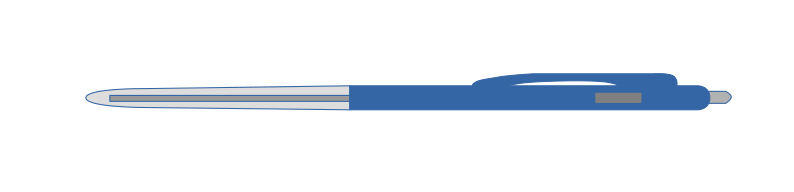
An example of an everyday device that can be modelled as a state machine
is a classic ballpoint pen, the retractable type where you push the end
to expose the tip and push the side to retract it. (A push-push pen
would also be an example but that type has only one event, so it is
less interesting)
```mermaid
---
title: Ballpoint Pen State Diagram
---
stateDiagram-v2
[*] --> Retracted
Retracted --> Retracted : push-side
Retracted --> Exposed : push-end
* Expose tip
Exposed --> Retracted : push-side
* Retract tip
Exposed --> Exposed : push-end
```
The state diagram shows the states, events, and state transitions
with transition actions. Note that pushing the end when the tip is exposed,
or pushing the side when the tip is retracted, does not change the state
nor cause any actions, which is modeled by an arrow back to the same state.
When to use gen_statem
----------------------
You should consider using `m:gen_statem` over `m:gen_server` if your
process logic is convenient to describe as a state machine and you
need any of these `m:gen_statem` key features:
- Co-located callback code for each state, for all
[_event types_](#event-types-and-event-content), such as _call_,
_cast_, and _info_
- [_Postponing events_](#postponing-events) - a substitute for selective
receive
- [_Inserted events_](#inserted-events) - events from the state
machine to itself; for purely internal events in particular
- [_State enter calls_](#state-enter-calls) - callback on state entry
co-located with the rest of each state's callback code
- Easy-to-use time-outs - [_state time-outs_](#state-time-outs),
[_event time-outs_](#event-time-outs), and
[_generic time-outs_](#generic-time-outs) (named time-outs)
For simple state machines not needing these features, `m:gen_server`
is perfectly suitable. It also has a smaller call overhead, but we are
talking about something like 2 vs 3.3 microseconds call roundtrip time
here, so if the server callback does just a little bit more than just
replying, or if calls are not extremely frequent, that difference
will be hard to notice.
Callback Module
---------------
The _callback module_ contains functions that implement the state
machine. When an event occurs, the `gen_statem` behaviour engine calls
a function in the _callback module_ with the event, current state, and
server data. This callback function performs the actions for the
event, and returns the new state and server data as well as actions to
be performed by the behaviour engine.
The behaviour engine holds the state machine state, server data, timer
references, a queue of postponed messages, and other metadata. It receives all
process messages, handles the system messages, and calls the _callback module_
with state machine specific events.
The _callback module_ can be changed for a running server using any of the
[_transition actions_](#transition-actions)
[`{change_callback_module, NewModule}`](`t:gen_statem:action/0`),
[`{push_callback_module, NewModule}`](`t:gen_statem:action/0`), or
[`pop_callback_module`](`t:gen_statem:action/0`).
> #### Note {: .info }
>
> Switching the callback module is a pretty esoteric thing to do...
>
> The origin for this feature is a protocol that after version
> negotiation branches off into quite different state machines depending
> on the protocol version. There _might_ be other use cases. _Beware_
> that the new callback module completely replaces the previous callback
> module, so all relevant callback functions have to handle the state
> and data from the previous callback module.
Callback Modes
--------------
The `gen_statem` behaviour supports two _callback modes_:
- **[`state_functions`](`t:gen_statem:callback_mode/0`)** - Events are handled
by one callback function per state.
- **[`handle_event_function`](`t:gen_statem:callback_mode/0`)** - Events are
handled by one single callback function.
The _callback mode_ is a property of the _callback module_ and is set at server
start. It may be changed due to a code upgrade/downgrade, or when changing the
_callback module_.
See the section [_State Callback_](#state-callback) that describes the
event handling callback function(s).
The _callback mode_ is selected by implementing a mandatory callback function
[`Module:callback_mode()`](`c:gen_statem:callback_mode/0`) that returns one of
the _callback modes_.
The [`Module:callback_mode()`](`c:gen_statem:callback_mode/0`) function
may also return a list containing the _callback mode_ and the atom
`state_enter` in which case [_state enter calls_](#state-enter-calls)
are activated for the _callback mode_.
### Choosing the Callback Mode
The short version: choose `state_functions` - it is the one most like
`m:gen_fsm`. But if you do not want the restriction that the state must be an
atom, or if you do not want to write one _state callback_ function per state,
please read on...
The two [_callback modes_](#callback-modes) give different
possibilities and restrictions, with one common goal: to handle all possible
combinations of events and states.
This can be done, for example, by focusing on one state at the time and for
every state ensure that all events are handled. Alternatively, you can focus
on one event at the time and ensure that it is handled in every state.
You can also use a mix of these strategies.
With `state_functions`, you are restricted to use atom-only states, and the
`m:gen_statem` engine branches depending on state name for you.
This encourages the _callback module_ to co-locate the implementation
of all event actions particular to one state in the same place in the code,
hence to focus on one state at the time.
This mode fits well when you have a regular state diagram, like the ones
in this chapter, which describes all events and actions belonging to a state
visually around that state, and each state has its unique name.
With `handle_event_function`, you are free to mix strategies, as all events
and states are handled in the same callback function.
This mode works equally well when you want to focus on one event
at the time or on one state at the time, but function
[`Module:handle_event/4`](`c:gen_statem:handle_event/4`) quickly grows
too large to handle without branching to helper functions.
The mode enables the use of non-atom states, for example, complex states,
or even hierarchical states. See section [_Complex State_](#complex-state).
If, for example, a state diagram is largely alike for the client side
and the server side of a protocol, you can have a state `{StateName, server}`,
or `{StateName, client}`, and make `StateName` determine where in the code
to handle most events in the state. The second element of the tuple
is then used to select whether to handle special client-side
or server-side events.
State Callback
--------------
The _state callback_ is the callback function that handles an event in the
current state, and which function that is depends on the _callback mode_:
- **`state_functions`** - The event is handled by:
[`Module:StateName(EventType, EventContent,
Data)`](`c:gen_statem:'StateName'/3`)
This form is the one mostly used in the [_Example_](#example) section.
- **`handle_event_function`** - The event is handled by:
[`Module:handle_event(EventType, EventContent, State,
Data)`](`c:gen_statem:handle_event/4`)
See section [_One State Callback_](#one-state-callback) for an example.
The state is either the name of the state callback itself, or an argument
to the [`handle_event()`](`c:gen_statem:handle_event/4`) callback. The
other arguments are the `EventType` and the event dependent `EventContent`,
both described in section
[_Event Types and Event Content_](#event-types-and-event-content),
and the last argument is the current server `Data`.
[_State Enter Calls_](#state-enter-calls) (see that section)
are also handled by the event handler and have slightly different arguments.
The _state callback_ return values are defined in the description of
[`Module:StateName/3`](`c:gen_statem:'StateName'/3`) in `m:gen_statem`.
Here is a maybe more readable list:
- **`{next_state, NextState, NewData [, Actions]}`**
Set next state and update the server data. If the `Actions` field is used,
execute [_Transition Actions_](#transition-actions)
(see that section). An empty `Actions` list is equivalent to not
returning the field.
If `NextState =/= State` it's a _state change_ and `gen_statem`
does some extra things: the event queue is restarted from the oldest
[postponed event](#postponing-events), any current
[_state time-out_](#state-time-outs) is canceled, and a
[_state enter call_](#state-enter-calls) is performed, if enabled.
The current `State` becomes `OldState` in a _state enter call_.
- **`{keep_state, NewData [, Actions]}`**
Same as the `next_state` values with `NextState =:= State`, that is,
no _state change_.
- **`keep_state_and_data | {keep_state_and_data, Actions}`**
Same as the `keep_state` values with `NextData =:= Data`, that is, no change
in server data.
- **`{repeat_state, NewData [, Actions]} |
repeat_state_and_data |{repeat_state_and_data, Actions}`**
Same as the `keep_state` or `keep_state_and_data` values, but if
[_state enter calls_](#state-enter-calls) are enabled;
repeat it as if this state was entered again. In this case `State`
and `OldState` becomes equal in the repeated _state enter call_
since the state is re-entered from itself.
- **`{stop, Reason [, NewData]}`**
Stop the server with reason `Reason`. If the `NewData` field is used,
first update the server data.
- **`{stop_and_reply, Reason, [NewData, ] ReplyActions}`**
Same as the `stop` values, but first execute the given
[_transition actions_](#transition-actions)
that may only be reply actions.
### The First State
To decide the first state the
[`Module:init(Args)`](`c:gen_statem:init/1`) callback function is called
before any [_state callback_](#state-callback) is called. This function
behaves like a _state callback_ function, but gets its only argument `Args`
from the `gen_statem` [`start/3,4`](`gen_statem:start/3`) or
[`start_link/3,4`](`gen_statem:start_link/3`) function, and returns
`{ok, State, Data}` or `{ok, State, Data, Actions}`. If you use the
[`postpone`](#postponing-events) action from this function, that action
is ignored, since there is no event to postpone.
Transition Actions
------------------
In the first section
([_Event-Driven State Machines_](#event-driven-state-machines)), actions
were mentioned as a part of the general state machine model. These general
actions are implemented with the code that _callback module_ `gen_statem`
executes in an event-handling callback function before returning to the
`m:gen_statem` engine.
There are more specific _transition actions_ that a callback function can
command the `gen_statem` engine to do after the callback function return.
These are commanded by returning a list of [_actions_](`t:gen_statem:action/0`)
in the [return value](`t:gen_statem:state_callback_result/2`) from the
[_callback function_](`c:gen_statem:'StateName'/3`). These are the possible
_transition actions_:
- **[`{postpone, Boolean}`](`t:gen_statem:postpone/0`)** -
If `true` postpone the current event, see section
[_Postponing Events_](#postponing-events).
- **[`{hibernate, Boolean}`](`t:gen_statem:hibernate/0`)** -
If `true` hibernate the `gen_statem`, treated in section
[_Hibernation_](#hibernation).
- **[`{state_timeout, Time, EventContent
[, Opts]}`](`t:gen_statem:state_timeout/0`)` |`**\
**[`{state_timeout, update,
EventContent}`](`t:gen_statem:timeout_update_action/0`)` |`**\
**[`{state_timeout, cancel}`](`t:gen_statem:timeout_cancel_action/0`)** -
Start, update, or cancel a _state time-out_, read more in sections
[_Time-Outs_](#time-outs) and
[_State Time-Outs_](#state-time-outs).
- **[`{{timeout, Name}, Time, EventContent
[, Opts]}`](`t:gen_statem:generic_timeout/0`)` |`**\
**[`{{timeout, Name}, update,
EventContent}`](`t:gen_statem:timeout_update_action/0`)` |`**\
**[`{{timeout, Name}, cancel}`](`t:gen_statem:timeout_cancel_action/0`)** -
Start, update, or cancel a _generic time-out_, read more in sections
[_Time-Outs_](#time-outs) and
[_Generic Time-Outs_](#generic-time-outs).
- **[`{timeout, Time, EventContent
[, Opts]}`](`t:gen_statem:event_timeout/0`)** -
Start an _event time-out_, see more in sections [_Time-Outs_](#time-outs)
and [_Event Time-Outs_](#event-time-outs).
- **[`{reply, From, Reply}`](`t:gen_statem:reply_action/0`)** - Reply to a
caller, mentioned at the end of section
[_All State Events_](#all-state-events).
- **[`{next_event, EventType, EventContent}`](`t:gen_statem:action/0`)** -
Generate the next event to handle, see section
[_Inserted Events_](#inserted-events).
- **[`{change_callback_module, NewModule}`](`t:gen_statem:action/0`)** -
Change the [_callback module_](#callback-module) for the running server.
This can be done during any _state transition_, whether it is
a _state change_ or not, but it _cannot_ be done from a
[_state enter call_](#state-enter-calls).
- **[`{push_callback_module, NewModule}`](`t:gen_statem:action/0`)** -
Push the current _callback module_ to the top of an internal stack
of callback modules and set the new [_callback module_](#callback-module)
for the running server. Otherwise like
`{change_callback_module, NewModule}` above.
- **[`pop_callback_module`](`t:gen_statem:action/0`)** - Pop the top module
from the internal stack of callback modules and set it to be the new
[_callback module_](#callback-module) for the running server. If the
stack is empty the server fails. Otherwise like
`{change_callback_module, NewModule}` above.
For details, see module `m:gen_statem` for type
[`action()`](`t:gen_statem:action/0`). You can, for example, reply to many
callers, generate multiple next events, and set a time-out to use absolute
instead of relative time (using the `Opts` field).
Out of these _transition actions_, the only immediate action is
`reply` for replying to a caller. The other actions are collected and
handled later during the _state transition_.
[_Inserted events_](#inserted-events) are stored and inserted all
together, and the rest set transition options where the last of a
specific type override the previous. See the description of a _state
transition_ in module `m:gen_statem` for type
[`transition_option()`](`t:gen_statem:transition_option/0`).
The different [_Time-Outs_](#time-outs) and
[`next_event`](#inserted-events) actions generate new events with
corresponding
[_event types and event content_](#event-types-and-event-content).
Event Types and Event Content
-----------------------------
Events are categorized in different
[_event types_](`t:gen_statem:event_type/0`). Events of all types are for a
given state handled in the same callback function, and that function gets
`EventType` and `EventContent` as arguments. The meaning of the `EventContent`
depends on the `EventType`.
The following is a complete list of _event types_ and from where they come:
- **[`cast`](`t:gen_statem:external_event_type/0`)** - Generated by
[`gen_statem:cast(ServerRef, Msg)`](`gen_statem:cast/2`) where `Msg` becomes
the `EventContent`.
- **[`{call, From}`](`t:gen_statem:external_event_type/0`)** - Generated by
[`gen_statem:call(ServerRef, Request)`](`gen_statem:call/2`),
[`gen_statem:send_request(ServerRef,
Request)`](`gen_statem:send_request/2`), or
[`gen_statem:send_request(ServerRef, Request,
_, _)`](`gen_statem:send_request/4`) where `Request` becomes
the `EventContent`. `From` is the reply address to use when replying
either through the _transition action_ `{reply, From, Reply}`,
or by calling [`gen_statem:reply(From, Reply)`](`gen_statem:reply/1`)
from the _callback module_.
- **[`info`](`t:gen_statem:external_event_type/0`)** - Generated by
any regular process message sent to the `gen_statem` process.
The process message becomes the `EventContent`.
- **[`state_timeout`](`t:gen_statem:timeout_event_type/0`)** - Generated by
_transition action_
[`{state_timeout, Time, EventContent}`](`t:gen_statem:timeout_action/0`)
when the time-out expires. Read more in sections [_Time-Outs_](#time-outs)
and [_State Time-Outs_](#state-time-outs).
- **[`{timeout, Name}`](`t:gen_statem:timeout_event_type/0`)** - Generated by
_transition action_
[`{{timeout, Name},Time, EventContent}`](`t:gen_statem:timeout_action/0`)
when the time-out expires. Read more in sections [_Time-Outs_](#time-outs)
and [_Generic Time-Outs_](#generic-time-outs).
- **[`timeout`](`t:gen_statem:timeout_event_type/0`)** - Generated by
_transition action_
[`{timeout, Time, EventContent}`](`t:gen_statem:timeout_action/0`)
(or its short form `Time`) when the time-out expires. Read more in sections
[_Time-Outs_](#time-outs) and [_Event Time-Outs_](#event-time-outs).
- **[`internal`](`t:gen_statem:event_type/0`)** - Generated by _transition
action_ [`{next_event, internal, EventContent}`](`t:gen_statem:action/0`).
All _event types_ above can also be generated using the `next_event` action:
`{next_event, EventType, EventContent}`.
State Enter Calls
-----------------
The `gen_statem` behaviour can, if this is enabled, regardless of _callback
mode_, automatically call the [_state callback_](`t:gen_statem:state_enter/0`)
with special arguments whenever the state changes, so you can write
state enter actions near the rest of the _state transition_ rules.
It typically looks like this:
```erlang
StateName(enter, OldState, Data) ->
... code for state enter actions here ...
{keep_state, NewData};
StateName(EventType, EventContent, Data) ->
... code for actions here ...
{next_state, NewStateName, NewData}.
```
Since the _state enter call_ is not an event there are restrictions on the
allowed return value and state [_transition actions_](#transition-actions).
You must not change the state, [postpone](#postponing-events) this non-event,
[insert any events](#inserted-events), or change the
[_callback module_](#callback-module).
The first state that is entered after `c:gen_statem:init/1` will get
a _state enter call_ with `OldState` equal to the current state.
You may repeat the _state enter call_ using the `{repeat_state,...}` return
value from the [_state callback_](#state-callback). In this case
`OldState` will also be equal to the current state.
Depending on how your state machine is specified, this can be a very useful
feature, but it forces you to handle the _state enter calls_ in all states.
See also the [_State Enter Actions_](#state-enter-actions) section.
Time-Outs
---------
Time-outs in `gen_statem` are started from a
[_transition action_](#transition-actions) during a state transition
that is when exiting from the [_state callback_](#state-callback).
There are 3 types of time-outs in `gen_statem`:
- **[`state_timeout`](`t:gen_statem:state_timeout/0`)** - There is one
[_state time-out_](#state-time-outs) that is automatically canceled by
a _state change_.
- **[`{timeout, Name}`](`t:gen_statem:generic_timeout/0`)** - There are any
number of [_generic time-outs_](#generic-time-outs) differing by their
`Name`. They have no automatic canceling.
- **[`timeout`](`t:gen_statem:event_timeout/0`)** - There is one
[_event time-out_](#event-time-outs) that is automatically canceled by
any event. Note that [postponed](#postponing-events) and
[inserted](#inserted-events) events cancel this time-out just as
external events do.
When a time-out is started, any running time-out of the same type
(`state_timeout`, `{timeout, Name}`, or `timeout`) is canceled, that is,
the time-out is restarted with the new time and event content.
All time-outs have an `EventContent` that is part of the
[_transition action_](#transition-actions) that starts the time-out.
Different `EventContent`s do not create different time-outs. The
`EventContent` is delivered to the [_state callback_](#state-callback)
when the time-out expires.
### Canceling a Time-Out
Starting a time-out with the `infinity` time value would never time out,
which is optimized by not even starting it, and any running
time-out with the same tag will be canceled. The `EventContent` will
in this case be ignored, so it makes sense to set it to `undefined`.
A more explicit way to cancel a time-out is to use a
[_transition action_](#transition-actions) on the form
[`{TimeoutType, cancel}`](`t:gen_statem:timeout_cancel_action/0`).
### Updating a Time-Out
While a time-out is running, its `EventContent` can be updated using a
[_transition action_](#transition-actions) on the form
[`{TimeoutType, update,
NewEventContent}`](`t:gen_statem:timeout_update_action/0`).
If this feature is used while no such `TimeoutType` is running, a time-out
event is immediately delivered as when starting a
[zero time-out](#zero-time-out).
### Zero Time-Out
If a time-out is started with the time `0` it will actually not be started.
Instead the time-out event will immediately be inserted to be processed after
any events already enqueued, and before any not yet received external events.
Note that some time-outs are automatically canceled so if you for example
combine [postponing](#postponing-events) an event in a _state change_
with starting an [_event time-out_](#event-time-outs) with time `0` there
will be no time-out event inserted since the _event time-out_ is canceled by
the postponed event that is delivered due to the state change.
Example
-------
A door with a code lock can be seen as a state machine. Initially,
the door is locked. When someone presses a button, a `{button, Button}`
event is generated. In the state diagram below, "Collect Buttons" means
to store buttons up to as many as in the correct code; append to
a length capped list. If correct, the door is unlocked for 10 seconds.
If incorrect, we wait for a new button to be pressed.
```mermaid
---
title: Code Lock State Diagram
---
stateDiagram-v2
state check_code <>
[*] --> locked : * do_lock()
* Clear Buttons
locked --> check_code : {button, Button}
* Collect Buttons
check_code --> locked : Incorrect code
check_code --> open : Correct code
* do_unlock()
* Clear Buttons
* Set state_timeout 10 s
open --> open : {button, Digit}
open --> locked : state_timeout
* do_lock()
```
This code lock state machine can be implemented using `m:gen_statem` with
the following _callback module_:
```erlang
-module(code_lock).
-behaviour(gen_statem).
-define(NAME, code_lock).
-export([start_link/1]).
-export([button/1]).
-export([init/1,callback_mode/0,terminate/3]).
-export([locked/3,open/3]).
start_link(Code) ->
gen_statem:start_link({local,?NAME}, ?MODULE, Code, []).
button(Button) ->
gen_statem:cast(?NAME, {button,Button}).
init(Code) ->
do_lock(),
Data = #{code => Code, length => length(Code), buttons => []},
{ok, locked, Data}.
callback_mode() ->
state_functions.
```
```erlang
locked(
cast, {button,Button},
#{code := Code, length := Length, buttons := Buttons} = Data) ->
NewButtons =
if
length(Buttons) < Length ->
Buttons;
true ->
tl(Buttons)
end ++ [Button],
if
NewButtons =:= Code -> % Correct
do_unlock(),
{next_state, open, Data#{buttons := []},
[{state_timeout,10_000,lock}]}; % Time in milliseconds
true -> % Incomplete | Incorrect
{next_state, locked, Data#{buttons := NewButtons}}
end.
```
```erlang
open(state_timeout, lock, Data) ->
do_lock(),
{next_state, locked, Data};
open(cast, {button,_}, Data) ->
{next_state, open, Data}.
```
```erlang
do_lock() ->
io:format("Lock~n", []).
do_unlock() ->
io:format("Unlock~n", []).
terminate(_Reason, State, _Data) ->
State =/= locked andalso do_lock(),
ok.
```
The code is explained in the next sections.
Starting gen_statem
-------------------
In the example in the previous section, `gen_statem` is started by calling
`code_lock:start_link(Code)`:
```erlang
start_link(Code) ->
gen_statem:start_link({local,?NAME}, ?MODULE, Code, []).
```
`start_link/1` calls function `gen_statem:start_link/4`,
which spawns and links to a new process, a `gen_statem`.
- The first argument, `{local,?NAME}`, specifies the name. In this case, the
`gen_statem` is locally registered as `code_lock` through the macro `?NAME`.
If the name is omitted, the `gen_statem` is not registered. Instead its pid
must be used. The name can also be specified as `{global, Name}`, then the
`gen_statem` is registered using `global:register_name/2` in Kernel.
- The second argument, `?MODULE`, is the name of the _callback module_,
that is, the module where the callback functions are located,
which is this module.
The interface functions (`start_link/1` and `button/1`) are located in the
same module as the callback functions (`init/1`, `locked/3`, and `open/3`).
It is normally good programming practice to have the client-side code
and the server-side code contained in the same module.
- The third argument, `Code`, is a list of digits, which is the correct
unlock code that is passed to callback function `init/1`.
- The fourth argument, `[]`, is a list of options. For the available options,
see `gen_statem:start_link/3`.
If name registration succeeds, the new `gen_statem` process calls callback
function `code_lock:init(Code)`. This function is expected to return
`{ok, State, Data}`, where `State` is the initial state of the `gen_statem`,
in this case `locked`; assuming that the door is locked to begin with.
`Data` is the internal server data of the `gen_statem`. Here the server data
is a [`map()`](`m:maps`) with key `code` that stores the correct
button sequence, key `length` stores its length, and key `buttons`
that stores the collected buttons up to the same length.
```erlang
init(Code) ->
do_lock(),
Data = #{code => Code, length => length(Code), buttons => []},
{ok, locked, Data}.
```
Function [`gen_statem:start_link/3,4`](`gen_statem:start_link/3`)
is synchronous. It does not return until the `gen_statem` is initialized
and is ready to receive events.
Function [`gen_statem:start_link/3,4`](`gen_statem:start_link/3`)
must be used if the `gen_statem` is part of a supervision tree, that is,
started by a supervisor. Function
[`gen_statem:start/3,4`](`gen_statem:start/3`) can be used to start
a standalone `gen_statem`, meaning it is not part of a supervision tree.
Function [`Module:callback_mode/0`](`c:gen_statem:callback_mode/0`) selects
the [`CallbackMode`](#callback-modes) for the _callback module_,
in this case [`state_functions`](`t:gen_statem:callback_mode/0`).
That is, each state has its own handler function:
```erlang
callback_mode() ->
state_functions.
```
Handling Events
---------------
The function notifying the code lock about a button event is implemented using
`gen_statem:cast/2`:
```erlang
button(Button) ->
gen_statem:cast(?NAME, {button,Button}).
```
The first argument is the name of the `gen_statem` and must agree with
the name used to start it. So, we use the same macro `?NAME` as when starting.
`{button, Button}` is the event content.
The event is sent to the `gen_statem`. When the event is received, the
`gen_statem` calls `StateName(cast, Event, Data)`, which is expected
to return a tuple `{next_state, NewStateName, NewData}`, or
`{next_state, NewStateName, NewData, Actions}`. `StateName` is the name
of the current state and `NewStateName` is the name of the next state.
`NewData` is a new value for the server data of the `gen_statem`,
and `Actions` is a list of actions to be performed by the `gen_statem` engine.
```erlang
locked(
cast, {button,Button},
#{code := Code, length := Length, buttons := Buttons} = Data) ->
NewButtons =
if
length(Buttons) < Length ->
Buttons;
true ->
tl(Buttons)
end ++ [Button],
if
NewButtons =:= Code -> % Correct
do_unlock(),
{next_state, open, Data#{buttons := []},
[{state_timeout,10_000,lock}]}; % Time in milliseconds
true -> % Incomplete | Incorrect
{next_state, locked, Data#{buttons := NewButtons}}
end.
```
In state `locked`, when a button is pressed, it is collected with the
previously pressed buttons up to the length of the correct code, then
compared with the correct code. Depending on the result, the door is
either unlocked and the `gen_statem` goes to state `open`, or the door
remains in state `locked`.
When changing to state `open`, the collected buttons are reset, the lock
unlocked, and a _state time-out_ for 10 seconds is started.
```erlang
open(cast, {button,_}, Data) ->
{next_state, open, Data}.
```
In state `open`, a button event is ignored by staying in the same state.
This can also be done by returning `{keep_state, Data}`, or in this case
since `Data` is unchanged, by returning `keep_state_and_data`.
State Time-Outs
---------------
When a correct code has been given, the door is unlocked and the following
tuple is returned from `locked/3`:
```erlang
{next_state, open, Data#{buttons := []},
[{state_timeout,10_000,lock}]}; % Time in milliseconds
```
10,000 is a time-out value in milliseconds. After this time (10 seconds),
a time-out occurs. Then, `StateName(state_timeout, lock, Data)` is called.
The time-out occurs when the door has been in state `open` for 10 seconds.
After that the door is locked again:
```erlang
open(state_timeout, lock, Data) ->
do_lock(),
{next_state, locked, Data};
```
The timer for a _state time-out_ is automatically canceled when
the state machine does a _state change_.
You can restart, cancel, or update a _state time-out_. See section
[_Time-Outs_](#time-outs) for details.
All State Events
----------------
Sometimes events can arrive in any state of the `gen_statem`. It is convenient
to handle these in a common state handler function that all state functions
call for events not specific to the state.
Consider a `code_length/0` function that returns the length
of the correct code. We dispatch all events that are not state-specific
to the common function `handle_common/3`:
```erlang
...
-export([button/1,code_length/0]).
...
code_length() ->
gen_statem:call(?NAME, code_length).
...
locked(...) -> ... ;
locked(EventType, EventContent, Data) ->
handle_common(EventType, EventContent, Data).
...
open(...) -> ... ;
open(EventType, EventContent, Data) ->
handle_common(EventType, EventContent, Data).
handle_common({call,From}, code_length, #{code := Code} = Data) ->
{keep_state, Data,
[{reply,From,length(Code)}]}.
```
Another way to do it is through a convenience macro `?HANDLE_COMMON/0`:
```erlang
...
-export([button/1,code_length/0]).
...
code_length() ->
gen_statem:call(?NAME, code_length).
-define(HANDLE_COMMON,
?FUNCTION_NAME(T, C, D) -> handle_common(T, C, D)).
%%
handle_common({call,From}, code_length, #{code := Code} = Data) ->
{keep_state, Data,
[{reply,From,length(Code)}]}.
...
locked(...) -> ... ;
?HANDLE_COMMON.
...
open(...) -> ... ;
?HANDLE_COMMON.
```
This example uses `gen_statem:call/2`, which waits for a reply from the server.
The reply is sent with a `{reply, From, Reply}` tuple in an action list in the
`{keep_state, ...}` tuple that retains the current state. This return form is
convenient when you want to stay in the current state but do not know or care
about what it is.
If the common _state callback_ needs to know the current state a function
`handle_common/4` can be used instead:
```erlang
-define(HANDLE_COMMON,
?FUNCTION_NAME(T, C, D) -> handle_common(T, C, ?FUNCTION_NAME, D)).
```
One State Callback
------------------
If [_callback mode_](#callback-modes) `handle_event_function` is used,
all events are handled in
[`Module:handle_event/4`](`c:gen_statem:handle_event/4`) and we can
(but do not have to) use an event-centered approach where we first branch
depending on event and then depending on state:
```erlang
...
-export([handle_event/4]).
...
callback_mode() ->
handle_event_function.
handle_event(cast, {button,Button}, State, #{code := Code} = Data) ->
case State of
locked ->
#{length := Length, buttons := Buttons} = Data,
NewButtons =
if
length(Buttons) < Length ->
Buttons;
true ->
tl(Buttons)
end ++ [Button],
if
NewButtons =:= Code -> % Correct
do_unlock(),
{next_state, open, Data#{buttons := []},
[{state_timeout,10_000,lock}]}; % Time in milliseconds
true -> % Incomplete | Incorrect
{keep_state, Data#{buttons := NewButtons}}
end;
open ->
keep_state_and_data
end;
handle_event(state_timeout, lock, open, Data) ->
do_lock(),
{next_state, locked, Data};
handle_event(
{call,From}, code_length, _State, #{code := Code} = Data) ->
{keep_state, Data,
[{reply,From,length(Code)}]}.
...
```
Stopping
--------
### In a Supervision Tree
If the `gen_statem` is part of a supervision tree, no stop function is needed.
The `gen_statem` is automatically terminated by its supervisor. Exactly how
this is done is defined by a [shutdown strategy](sup_princ.md#shutdown)
set in the supervisor.
If it is necessary to clean up before termination, the shutdown strategy
must be a time-out value and the `gen_statem` must in function `init/1`
set itself to trap exit signals by calling
[`process_flag(trap_exit, true)`](`erlang:process_flag/2`):
```erlang
init(Args) ->
process_flag(trap_exit, true),
do_lock(),
...
```
When ordered to shut down, the `gen_statem` then calls callback function
`terminate(shutdown, State, Data)`.
In this example, function `terminate/3` locks the door if it is open,
so we do not accidentally leave the door open
when the supervision tree terminates:
```erlang
terminate(_Reason, State, _Data) ->
State =/= locked andalso do_lock(),
ok.
```
### Standalone gen_statem
If the `gen_statem` is not part of a supervision tree, it can be stopped
using [`gen_statem:stop/1`](`gen_statem:stop/1`), preferably through
an API function:
```erlang
...
-export([start_link/1,stop/0]).
...
stop() ->
gen_statem:stop(?NAME).
```
This makes the `gen_statem` call callback function `terminate/3` just like
for a supervised server and waits for the process to terminate.
Event Time-Outs
---------------
A time-out feature inherited from `gen_statem`'s predecessor `m:gen_fsm`,
is an _event time-out_, that is, if an event arrives the timer is canceled.
You get either an event or a time-out, but not both.
It is ordered by the
[_transition action_](#transition-actions) `{timeout, Time, EventContent}`,
or just an integer `Time`, even without the enclosing actions list (the latter
is a form inherited from `gen_fsm`).
This type of time-out is useful, for example, to act on inactivity.
Let's restart the code sequence if no button is pressed for say 30 seconds:
```erlang
...
locked(timeout, _, Data) ->
{next_state, locked, Data#{buttons := []}};
locked(
cast, {button,Button},
#{code := Code, length := Length, buttons := Buttons} = Data) ->
...
true -> % Incomplete | Incorrect
{next_state, locked, Data#{buttons := NewButtons},
30_000} % Time in milliseconds
...
```
Whenever we receive a button event we start an _event time-out_ of 30 seconds,
and if we get an _event type_ of `timeout` we reset the remaining
code sequence.
An _event time-out_ is canceled by any other event so you either get
some other event or the time-out event. Therefore, canceling,
restarting, or updating an _event time-out_ is neither possible nor
necessary. Whatever event you act on has already canceled
the _event time-out_, so there is never a running _event time-out_
while the _state callback_ executes.
Note that an _event time-out_ does not work well when you have for example a
status call as in section [_All State Events_](#all-state-events), or
handle unknown events, since all kinds of events will cancel
the _event time-out_.
Generic Time-Outs
-----------------
The previous example of _state time-outs_ only works if the state machine stays
in the same state during the time-out time. And _event time-outs_ only work
if no disturbing unrelated events occur.
You may want to start a timer in one state and respond to the time-out in
another, maybe cancel the time-out without changing states, or perhaps run
multiple time-outs in parallel. All this can be accomplished with
[_generic time-outs_](`t:gen_statem:generic_timeout/0`). They may look a little
bit like [_event time-outs_](`t:gen_statem:event_timeout/0`) but contain
a name to allow for any number of them simultaneously and they are
not automatically canceled.
Here is how to accomplish the _state time-out_ in the previous example
by instead using a _generic time-out_ named for example `open`:
```erlang
...
locked(
cast, {button,Button},
#{code := Code, length := Length, buttons := Buttons} = Data) ->
...
if
NewButtons =:= Code -> % Correct
do_unlock(),
{next_state, open, Data#{buttons := []},
[{{timeout,open},10_000,lock}]}; % Time in milliseconds
...
open({timeout,open}, lock, Data) ->
do_lock(),
{next_state,locked,Data};
open(cast, {button,_}, Data) ->
{keep_state,Data};
...
```
Specific _generic time-outs_ can just as [_state time-outs_](#state-time-outs)
be restarted or canceled by setting it to a new time or `infinity`.
In this particular case we do not need to cancel the time-out since
the time-out event is the only possible reason to do a _state change_
from `open` to `locked`.
Instead of bothering with when to cancel a time-out, a late time-out event
can be handled by ignoring it if it arrives in a state
where it is known to be late.
You can restart, cancel, or update a _generic time-out_.
See section [_Time-Outs_](#time-outs) for details.
Erlang Timers
-------------
The most versatile way to handle time-outs is to use Erlang Timers; see
[`erlang:start_timer/3,4`](`erlang:start_timer/4`). Most time-out tasks
can be performed with the time-out features in `m:gen_statem`,
but an example of one that cannot is if you should need the return value
from [`erlang:cancel_timer(Tref)`](`erlang:cancel_timer/2`), that is,
the remaining time of the timer.
Here is how to accomplish the _state time-out_ in the previous example
by instead using an Erlang Timer:
```erlang
...
locked(
cast, {button,Button},
#{code := Code, length := Length, buttons := Buttons} = Data) ->
...
if
NewButtons =:= Code -> % Correct
do_unlock(),
Tref =
erlang:start_timer(
10_000, self(), lock), % Time in milliseconds
{next_state, open, Data#{buttons := [], timer => Tref}};
...
open(info, {timeout,Tref,lock}, #{timer := Tref} = Data) ->
do_lock(),
{next_state,locked,maps:remove(timer, Data)};
open(cast, {button,_}, Data) ->
{keep_state,Data};
...
```
Removing the `timer` key from the map when we do a _state change_ to `locked`
is not strictly necessary since we can only get into state `open`
with an updated `timer` map value. But it can be nice to not have
outdated values in the state `Data`.
If you need to cancel a timer because of some other event, you can use
[`erlang:cancel_timer(Tref)`](`erlang:cancel_timer/2`). Note that no time-out
message will arrive after this (because the timer has been
explicitly canceled), unless you have already postponed one earlier
(see the next section), so ensure that you do not accidentally
postpone such messages. Also note that a time-out message may arrive
during a _state callback_ that is canceling the timer, so you may have to
read out such a message from the process mailbox, depending on
the return value from [`erlang:cancel_timer(Tref)`](`erlang:cancel_timer/2`).
Another way to handle a late time-out can be to not cancel it, but to ignore it
if it arrives in a state where it is known to be late.
Postponing Events
-----------------
If you want to ignore a particular event in the current state and handle it
in a future state, you can postpone the event. A postponed event
is retried after a _state change_, that is, `OldState =/= NewState`.
Postponing is ordered by the
[_transition action_](#transition-actions) `postpone`.
In this example, instead of ignoring button events while in the `open` state,
we can postpone them and handle them later in the `locked` state:
```erlang
...
open(cast, {button,_}, Data) ->
{keep_state,Data,[postpone]};
...
```
Since a postponed event is only retried after a _state change_, you have to
think about where to keep a state data item. You can keep it in the server
`Data` or in the `State` itself, for example by having two more or less
identical states to keep a boolean value, or by using a complex state (see
section [_Complex State_](#complex-state)) with
[_callback mode_](#callback-modes)
[`handle_event_function`](`t:gen_statem:callback_mode/0`). If a change
in the value changes the set of events that is handled, the value
should be in the State. Otherwise no postponed events will be retried
since only the server `Data` changes.
This is important if events are postponed. But remember that an incorrect
design decision of what belongs in the state, may become a hard to find bug
some time later, when event postponing is introduced.
### Fuzzy State Diagrams
It is not uncommon that a state diagram does not specify how to handle events
that are not illustrated in a particular state in the diagram.
Hopefully this is described in an associated text or from the context.
Possible actions: ignore as in drop the event (maybe log it) or deal with
the event in some other state as in postpone it.
### Selective Receive
Erlang's selective `receive` statement is often used to describe simple state
machine examples in straightforward Erlang code. The following is a possible
implementation of the first example:
```erlang
-module(code_lock).
-define(NAME, code_lock_1).
-export([start_link/1,button/1]).
start_link(Code) ->
spawn(
fun () ->
true = register(?NAME, self()),
do_lock(),
locked(Code, length(Code), [])
end).
button(Button) ->
?NAME ! {button,Button}.
```
```erlang
locked(Code, Length, Buttons) ->
receive
{button,Button} ->
NewButtons =
if
length(Buttons) < Length ->
Buttons;
true ->
tl(Buttons)
end ++ [Button],
if
NewButtons =:= Code -> % Correct
do_unlock(),
open(Code, Length);
true -> % Incomplete | Incorrect
locked(Code, Length, NewButtons)
end
end.
```
```erlang
open(Code, Length) ->
receive
after 10_000 -> % Time in milliseconds
do_lock(),
locked(Code, Length, [])
end.
do_lock() ->
io:format("Locked~n", []).
do_unlock() ->
io:format("Open~n", []).
```
The selective receive in this case causes `open` to implicitly postpone any
events to the `locked` state.
A catch-all receive should never be used from a `gen_statem` behaviour
(or from any `gen_*` behaviour), as the receive statement is within
the `gen_*` engine itself. `m:sys`-compatible behaviours must respond to
system messages and therefore do that in their engine receive loop,
passing non-system messages to the _callback module_. Using a catch-all
receive can result in system messages being discarded, which in turn
can lead to unexpected behaviour. If a selective receive must be used,
great care should be taken to ensure that only messages pertinent
to the operation are received. Likewise, a callback must return
in due time to let the engine receive loop handle system messages,
or they might time out, also leading to unexpected behaviour.
The [_transition action_](#transition-actions) `postpone` is
designed to model selective receives. A selective receive implicitly
postpones any events not yet received, but the `postpone` _transition
action_ explicitly postpones a single received event.
Both mechanisms have the same theoretical time and memory complexity,
but note that the selective receive language construct has smaller
constant factors.
State Enter Actions
-------------------
Say you have a state machine specification that uses state enter actions.
Although you can code this using inserted events (described in the next
section), especially if only one or a few states have state enter actions,
this is a perfect use case for the built in
[_state enter calls_](#state-enter-calls).
You return a list containing `state_enter` from your
[`callback_mode/0`](`c:gen_statem:callback_mode/0`) function and the
`gen_statem` engine will call your _state callback_ once with an event
`(enter, OldState, ...)` whenever it does a _state change_. Then you
just need to handle these event-like calls in all states.
```erlang
...
init(Code) ->
process_flag(trap_exit, true),
Data = #{code => Code, length => length(Code)},
{ok, locked, Data}.
callback_mode() ->
[state_functions,state_enter].
locked(enter, _OldState, Data) ->
do_lock(),
{keep_state,Data#{buttons => []}};
locked(
cast, {button,Button},
#{code := Code, length := Length, buttons := Buttons} = Data) ->
...
if
NewButtons =:= Code -> % Correct
{next_state, open, Data};
...
open(enter, _OldState, _Data) ->
do_unlock(),
{keep_state_and_data,
[{state_timeout,10_000,lock}]}; % Time in milliseconds
open(state_timeout, lock, Data) ->
{next_state, locked, Data};
...
```
You can repeat the state enter code by returning one of
`{repeat_state, ...}`,`{repeat_state_and_data, _}`,
or `repeat_state_and_data` that otherwise behaves exactly like their
`keep_state` siblings. See the type
[`state_callback_result()`](`t:gen_statem:state_callback_result/2`)
in the Reference Manual.
Inserted Events
---------------
It can sometimes be beneficial to be able to generate events to your own
state machine. This can be done with the
[_transition action_](#transition-actions)
[`{next_event, EventType, EventContent}`](`t:gen_statem:action/0`).
You can generate events of any existing [type](`t:gen_statem:action/0`),
but the `internal` type can only be generated through action `next_event`.
Hence, it cannot come from an external source, so you can be certain
that an `internal` event is an event from your state machine to itself.
One example for this is to pre-process incoming data, for example decrypting
chunks or collecting characters up to a line break.
Purists may argue that this should be modeled with a separate state machine
that sends pre-processed events to the main state machine.
However, for efficiency's sake, the small pre-processing state machine
can be integrated into the common event handling of the main state
machine. This integration involves using a few state data items
to dispatch pre-processed events as internal events to the main state
machine.
Using internal events also can make it easier to synchronize the state
machines.
A variant of this is to use a [complex state](#complex-state) with
[one state callback](#one-state-callback), modeling the state
with, for example, a tuple `{MainFSMState, SubFSMState}`.
To illustrate this we make up an example where the buttons instead generate
down and up (press and release) events, and the lock responds
to an up event only after the corresponding down event.
```erlang
...
-export([down/1, up/1]).
...
down(Button) ->
gen_statem:cast(?NAME, {down,Button}).
up(Button) ->
gen_statem:cast(?NAME, {up,Button}).
...
locked(enter, _OldState, Data) ->
do_lock(),
{keep_state,Data#{buttons => []}};
locked(
internal, {button,Button},
#{code := Code, length := Length, buttons := Buttons} = Data) ->
...
```
```erlang
handle_common(cast, {down,Button}, Data) ->
{keep_state, Data#{button => Button}};
handle_common(cast, {up,Button}, Data) ->
case Data of
#{button := Button} ->
{keep_state,maps:remove(button, Data),
[{next_event,internal,{button,Button}}]};
#{} ->
keep_state_and_data
end;
...
open(internal, {button,_}, Data) ->
{keep_state,Data,[postpone]};
...
```
If you start this program with `code_lock:start([17])` you can unlock with
`code_lock:down(17), code_lock:up(17).`
Example Revisited
-----------------
This section includes the example after most of the mentioned modifications
and some more using _state enter calls_, which deserves a new state diagram:
```mermaid
---
title: Code Lock State Diagram Revisited
---
stateDiagram-v2
state enter_locked <>
state enter_open <>
state check_code <>
[*] --> enter_locked
enter_locked --> locked : * do_lock()
* Clear Buttons
locked --> check_code : {button, Button}
* Collect Buttons
locked --> locked : state_timeout
* Clear Buttons
check_code --> locked : Incorrect code
* Set state_timeout 30 s
check_code --> enter_open : Correct code
enter_open --> open : * do_unlock()
* Set state_timeout 10 s
open --> enter_locked : state_timeout
```
Notice that this state diagram does not specify how to handle a button event
in the state `open`. So, you need to read in some side notes, that is, here:
that unspecified events shall be postponed (handled in some later state).
Also, the state diagram does not show that the `code_length/0` call
must be handled in every state.
### Callback Mode: state_functions
Using state functions:
```erlang
-module(code_lock).
-behaviour(gen_statem).
-define(NAME, code_lock_2).
-export([start_link/1,stop/0]).
-export([down/1,up/1,code_length/0]).
-export([init/1,callback_mode/0,terminate/3]).
-export([locked/3,open/3]).
start_link(Code) ->
gen_statem:start_link({local,?NAME}, ?MODULE, Code, []).
stop() ->
gen_statem:stop(?NAME).
down(Button) ->
gen_statem:cast(?NAME, {down,Button}).
up(Button) ->
gen_statem:cast(?NAME, {up,Button}).
code_length() ->
gen_statem:call(?NAME, code_length).
```
```erlang
init(Code) ->
process_flag(trap_exit, true),
Data = #{code => Code, length => length(Code), buttons => []},
{ok, locked, Data}.
callback_mode() ->
[state_functions,state_enter].
-define(HANDLE_COMMON,
?FUNCTION_NAME(T, C, D) -> handle_common(T, C, D)).
%%
handle_common(cast, {down,Button}, Data) ->
{keep_state, Data#{button => Button}};
handle_common(cast, {up,Button}, Data) ->
case Data of
#{button := Button} ->
{keep_state, maps:remove(button, Data),
[{next_event,internal,{button,Button}}]};
#{} ->
keep_state_and_data
end;
handle_common({call,From}, code_length, #{code := Code}) ->
{keep_state_and_data,
[{reply,From,length(Code)}]}.
```
```erlang
locked(enter, _OldState, Data) ->
do_lock(),
{keep_state, Data#{buttons := []}};
locked(state_timeout, button, Data) ->
{keep_state, Data#{buttons := []}};
locked(
internal, {button,Button},
#{code := Code, length := Length, buttons := Buttons} = Data) ->
NewButtons =
if
length(Buttons) < Length ->
Buttons;
true ->
tl(Buttons)
end ++ [Button],
if
NewButtons =:= Code -> % Correct
{next_state, open, Data};
true -> % Incomplete | Incorrect
{keep_state, Data#{buttons := NewButtons},
[{state_timeout,30_000,button}]} % Time in milliseconds
end;
?HANDLE_COMMON.
```
```erlang
open(enter, _OldState, _Data) ->
do_unlock(),
{keep_state_and_data,
[{state_timeout,10_000,lock}]}; % Time in milliseconds
open(state_timeout, lock, Data) ->
{next_state, locked, Data};
open(internal, {button,_}, _) ->
{keep_state_and_data, [postpone]};
?HANDLE_COMMON.
do_lock() ->
io:format("Locked~n", []).
do_unlock() ->
io:format("Open~n", []).
terminate(_Reason, State, _Data) ->
State =/= locked andalso do_lock(),
ok.
```
### Callback Mode: handle_event_function
This section describes what to change in the example to use one
`handle_event/4` function. The previously used approach to first branch
depending on event does not work that well here because of
the _state enter calls_, so this example first branches depending on state:
```erlang
-export([handle_event/4]).
```
```erlang
callback_mode() ->
[handle_event_function,state_enter].
```
```erlang
%%
%% State: locked
handle_event(enter, _OldState, locked, Data) ->
do_lock(),
{keep_state, Data#{buttons := []}};
handle_event(state_timeout, button, locked, Data) ->
{keep_state, Data#{buttons := []}};
handle_event(
internal, {button,Button}, locked,
#{code := Code, length := Length, buttons := Buttons} = Data) ->
NewButtons =
if
length(Buttons) < Length ->
Buttons;
true ->
tl(Buttons)
end ++ [Button],
if
NewButtons =:= Code -> % Correct
{next_state, open, Data};
true -> % Incomplete | Incorrect
{keep_state, Data#{buttons := NewButtons},
[{state_timeout,30_000,button}]} % Time in milliseconds
end;
```
```erlang
%%
%% State: open
handle_event(enter, _OldState, open, _Data) ->
do_unlock(),
{keep_state_and_data,
[{state_timeout,10_000,lock}]}; % Time in milliseconds
handle_event(state_timeout, lock, open, Data) ->
{next_state, locked, Data};
handle_event(internal, {button,_}, open, _) ->
{keep_state_and_data,[postpone]};
```
```erlang
%% Common events
handle_event(cast, {down,Button}, _State, Data) ->
{keep_state, Data#{button => Button}};
handle_event(cast, {up,Button}, _State, Data) ->
case Data of
#{button := Button} ->
{keep_state, maps:remove(button, Data),
[{next_event,internal,{button,Button}},
{state_timeout,30_000,button}]}; % Time in milliseconds
#{} ->
keep_state_and_data
end;
handle_event({call,From}, code_length, _State, #{length := Length}) ->
{keep_state_and_data,
[{reply,From,Length}]}.
```
Notice that postponing buttons from the `open` state to the `locked` state
seems like a strange thing to do for a code lock, but it at least
illustrates event postponing.
Filter the State
----------------
The example servers so far in this chapter print the full internal state
in the error log, for example, when killed by an exit signal or because of
an internal error. The state contains both the code lock code
and which digits that remain to unlock.
This state data can be regarded as sensitive, and maybe not what you want
in the error log because of some unpredictable event.
Another reason to filter the state can be that the state is too large to print,
as it fills the error log with uninteresting details.
To avoid this, you can format the internal state that gets in the error log
and gets returned from [`sys:get_status/1,2`](`sys:get_status/1`)
by implementing function
[`Module:format_status/2`](`c:gen_statem:format_status/2`),
for example like this:
```erlang
...
-export([init/1,terminate/3,format_status/2]).
...
format_status(Opt, [_PDict,State,Data]) ->
StateData =
{State,
maps:filter(
fun (code, _) -> false;
(_, _) -> true
end,
Data)},
case Opt of
terminate ->
StateData;
normal ->
[{data,[{"State",StateData}]}]
end.
```
It is not mandatory to implement a
[`Module:format_status/2`](`c:gen_statem:format_status/2`) function.
If you do not, a default implementation is used that does the same
as this example function without filtering the `Data` term, that is,
`StateData = {State, Data}`, in this example containing sensitive information.
Complex State
-------------
The _callback mode_ [`handle_event_function`](`t:gen_statem:callback_mode/0`)
enables using a non-atom state as described in section
[_Callback Modes_](#callback-modes), for example, a complex state term
like a tuple.
One reason to use this is when you have a state item that when changed
should cancel the [_state time-out_](#state-time-outs), or one that affects
the event handling in combination with postponing events. We will go for
the latter and complicate the previous example by introducing
a configurable lock button (this is the state item in question),
which in the `open` state immediately locks the door, and an API function
`set_lock_button/1` to set the lock button.
Suppose now that we call `set_lock_button` while the door is open,
and we have already postponed a button event that was the new lock button:
```erlang
1> code_lock:start_link([a,b,c], x).
{ok,<0.666.0>}
2> code_lock:button(a).
ok
3> code_lock:button(b).
ok
4> code_lock:button(c).
ok
Open
5> code_lock:button(y).
ok
6> code_lock:set_lock_button(y).
x
% What should happen here? Immediate lock or nothing?
```
We could say that the button was pressed too early so it should not be
recognized as the lock button. Or we can make the lock button part of
the state so when we then change the lock button in the locked state,
the change becomes a _state change_ and all postponed events are retried,
therefore the lock is immediately locked\!
We define the state as `{StateName, LockButton}`, where `StateName`
is as before and `LockButton` is the current lock button:
```erlang
-module(code_lock).
-behaviour(gen_statem).
-define(NAME, code_lock_3).
-export([start_link/2,stop/0]).
-export([button/1,set_lock_button/1]).
-export([init/1,callback_mode/0,terminate/3]).
-export([handle_event/4]).
start_link(Code, LockButton) ->
gen_statem:start_link(
{local,?NAME}, ?MODULE, {Code,LockButton}, []).
stop() ->
gen_statem:stop(?NAME).
button(Button) ->
gen_statem:cast(?NAME, {button,Button}).
set_lock_button(LockButton) ->
gen_statem:call(?NAME, {set_lock_button,LockButton}).
```
```erlang
init({Code,LockButton}) ->
process_flag(trap_exit, true),
Data = #{code => Code, length => length(Code), buttons => []},
{ok, {locked,LockButton}, Data}.
callback_mode() ->
[handle_event_function,state_enter].
%% State: locked
handle_event(enter, _OldState, {locked,_}, Data) ->
do_lock(),
{keep_state, Data#{buttons := []}};
handle_event(state_timeout, button, {locked,_}, Data) ->
{keep_state, Data#{buttons := []}};
handle_event(
cast, {button,Button}, {locked,LockButton},
#{code := Code, length := Length, buttons := Buttons} = Data) ->
NewButtons =
if
length(Buttons) < Length ->
Buttons;
true ->
tl(Buttons)
end ++ [Button],
if
NewButtons =:= Code -> % Correct
{next_state, {open,LockButton}, Data};
true -> % Incomplete | Incorrect
{keep_state, Data#{buttons := NewButtons},
[{state_timeout,30_000,button}]} % Time in milliseconds
end;
```
```erlang
%%
%% State: open
handle_event(enter, _OldState, {open,_}, _Data) ->
do_unlock(),
{keep_state_and_data,
[{state_timeout,10_000,lock}]}; % Time in milliseconds
handle_event(state_timeout, lock, {open,LockButton}, Data) ->
{next_state, {locked,LockButton}, Data};
handle_event(cast, {button,LockButton}, {open,LockButton}, Data) ->
{next_state, {locked,LockButton}, Data};
handle_event(cast, {button,_}, {open,_}, _Data) ->
{keep_state_and_data,[postpone]};
```
```erlang
%%
%% Common events
handle_event(
{call,From}, {set_lock_button,NewLockButton},
{StateName,OldLockButton}, Data) ->
{next_state, {StateName,NewLockButton}, Data,
[{reply,From,OldLockButton}]}.
```
```erlang
do_lock() ->
io:format("Locked~n", []).
do_unlock() ->
io:format("Open~n", []).
terminate(_Reason, State, _Data) ->
State =/= locked andalso do_lock(),
ok.
```
Hibernation
-----------
If you have many servers in one node and they have some state(s) in their
lifetime in which the servers can be expected to idle for a while, and the
amount of heap memory all these servers need is a problem, then the memory
footprint of a server can be minimized by hibernating it through
`proc_lib:hibernate/3`.
> #### Note {: .info }
>
> It is rather costly to hibernate a process; see `erlang:hibernate/3`. It is
> not something you want to do after every event.
We can in this example hibernate in the `{open, _}` state,
because what normally occurs in that state is that the _state time-out_
after a while triggers a transition to `{locked, _}`:
```erlang
...
%%
%% State: open
handle_event(enter, _OldState, {open,_}, _Data) ->
do_unlock(),
{keep_state_and_data,
[{state_timeout,10_000,lock}, % Time in milliseconds
hibernate]};
...
```
The atom [`hibernate`](`t:gen_statem:hibernate/0`) in the action list on the
last line when entering the `{open, _}` state is the only change. If any event
arrives in the `{open, _},` state, we do not bother to rehibernate,
so the server stays awake after any event.
To change that we would need to insert action `hibernate` in more places.
For example, the state-independent `set_lock_button` operation
would have to use `hibernate` but only in the `{open, _}` state,
which would clutter the code.
Another not uncommon scenario is to use the
[_event time-out_](#event-time-outs) to trigger hibernation after a
certain time of inactivity. There is also a server start option
[`{hibernate_after, Timeout}`](`t:gen_statem:enter_loop_opt/0`) for
[`start/3,4`](`gen_statem:start/3`),
[`start_link/3,4`](`gen_statem:start_link/3`), or
[`enter_loop/4,5,6`](`gen_statem:enter_loop/4`) that may be used to
automatically hibernate the server.
This particular server probably does not use heap memory worth hibernating for.
To gain anything from hibernation, your server would have to produce
non-insignificant garbage during callback execution, for which this example
server can serve as a bad example.